Tuesday, January 18, 2011

January 18, 1963 The Frances Hubbard Diaries,

January 18, 1963
Fri Partly Cloudy in am but 40 warm and very little wind.  I washed clothes and hung outside they dried good.  The men finished Davids car, then he and Doug went to Cobleskill in P.M. to return some parts.  Carol and Wayne went to game at night on bus.  Doug and David went out.  Lavilla asked us over to play 42 but I was sort of sick had headache all day and didn’t feel like going.
Comment:  42, also known as Texas 42, is a trick-taking game played with a standard set of double-six dominoes. 42 is often referred to as the "national game of Texas", and continues to be very popular in much of the state.[1] Tournaments are held in many towns,[1] and the State Championship tournament is held in Hallettsville the first Saturday of March each year.[2]
This is about the only game that my mother would play and she loved it.  Probably because it is also the answer to life, the universe and everything.  
Image result for Why 42 is the answer to life the universe and everything?
In The Hitchhiker's Guide to the Galaxy, advanced alien beings create a supercomputer, called Deep Thought, to figure out the answer to the so-called Ultimate Question of Life, the Universe, and Everything. After calculating for 7.5-million years, Deep Thought determined the answer was the number 42.


Monday, January 17, 2011

January 17, 1963 The Frances Hubbard Diaries


January 17, 1963
Cloudy and warm 30’s windy in a.m.  Men fixed the garage and worked on David's car.  I wrote to Marilyn.   Went to all day missionary meeting at Lavilla's.  David and Doug went to Cobleskill  about 3:30 after parts for Davids car.  Girls and I went to Leonards (Reynolds?) to prayer meeting.  LaVerne and Roberta were here while we were gone.
Comment:  I think David's car was a 1957 Plymouth Fury similar to the car below.  I remember seeing this car on a winter morning after David had come home from somewhere.    It was in the winter and the roads were very slippery.  That morning the rear of the car sagged very low to the ground.  David had put a concrete guard rail post in the trunk so he could get up the hills out of North Blenheim and the hills up around Earle's pond.


Sunday, January 16, 2011

January 16, 1963: The Frances Hubbard Diaries


January 16, 1963
Wed Partly Cloudy and Cold -8 to 12 above.  I worked on Sues dress  Clifton,  Doug and David put stove up in garage and boys went to Middleburg after wire and wall board for garage.  Gerald called at night and said he and Mary Ann would be here Sunday for dinner,  David took our car and went to Roxbury.  

Comment:  Wow, another cold day.  I can remember  getting up in the morning in that old house when it was -8 degrees.  I think David was going to Roxbury to see a girl.  
The garage was reconstructed from the old second  barn and chicken house that used to stand behind the big red barn.  This  picture is dated from probably 10 years earlier in 1953.    All five boys and Dad are working on the garage.  From left to right:  LaVerne, David standing behind Wayne, Doug, Gerald, Clifton J.  

Saturday, January 15, 2011

January 15, 1963: The Frances Hubbard Diaries

January 15, 1963
Tues  Partly cloudy cold 15 high Clifton and I went to Cobleskill and to mothers for dinner.  Survey guys were here in the a.m. about surveying the mountain. Snow squalls at night.
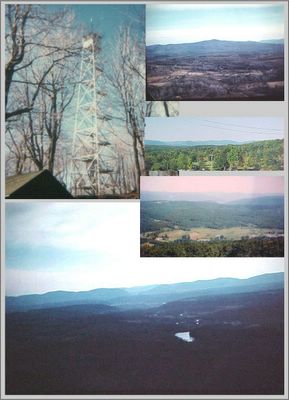
Comment:  New York State was in the process of buying the Hubbard Hill mountain through condemnation proceedings so Dad did not have a choice.  Cannot remember what he was paid for it.  The state had placed a fire tower on the mountain in the late forties and the mountain was quite an attraction for local folks and the "boarders".  One of the problems I remember was that people would walk or drive up through the lot behind the house and would leave the gates open so the cows would get out.  Their vehicles would also leave deep ruts in the field.  Following are some tower pictures and a link to my previous blog about the mountain and tower.

Swinging In The Barn


I was working around the west end of the barn one day.  It must have been about 1952.  Wayne was about six years old.

Something caused a disturbance and I remember Wayne walking down the road in front of the barn saying over and over “I think I’m going crazy” and he was obviously very distressed.

When we asked him what happened, he said that he had been swinging on the ropes in the barn and on one swing, he had crashed his head into one of the upright beams in the barn.

We used to take the hay ropes and tie them off on one of rafters, then stand on one of the large horizontal beams,  probably about 15 feet high, swing off the beam, arc up then drop into a pile of hay in the mow or stacked on the barn floor.

I remember Wayne being very pale and disoriented for quite a while.  I’ve often wondered if this accident contributed to the rather tortured life he seemed to lead.

Tar Baby

I must have been around three of four years old when I decided to leave Aunt Madeline & Clarence’s and walk home up the hills by Earl’s pond.  They lived in an old converted one-room school house.  Herman Huber lived there after the war.
 
I remember it was a very warm and sunny day and I’m not sure why I was there, probably to get me out of the families hair while they were doing something.

Anyway, the road leading up the hill in front of the house had been recently paved with large stones and asphalt.   The stones used were anywhere from about an inch to 2 inches in diameter which left ample room between the stones for the tar to collect.

I remember walking about halfway up the hill, then sitting down on the road and sticking my fingers into the warm tar and then pulling them out.  I did this for awhile, thoroughly coating my hands, clothes & arms, I even remember tasting it.  Overall I remember it as a quite pleasant experience.  The sun was warm and the hot tar comforting somehow.

Not sure how long I was there before Uncle Earl came driving up the hill.  He stopped and I remember his smiling face as he talked to me.  I remember riding in his car, a green coupe,  and then I remember my mother greeting us laughingly as we arrived at the house.  She was with several other women, the Hubbard aunts, I suppose.  I remember her cleaning me up with a cloth doused in kerosene but little else about the day.
Comment by Susan Hubbard Ciccci:

Gerry,  I’m just getting to read all of your postings.  I remember playing in the tar too, on the hill by the old butternut tree.  The tar would bubble up and the road would be loaded with all of these various sized tar bubbles, and we used to pop them with our fingers, shoes, the tires of the bike.  On time, Danny, Marilyn and Roland were visits from CA., and I think David and Craig were there, as well as John, Chris, Dougie and Jeff, Wayne’s kids: all of the cousins that age, and they got in the tar = DANNY especially, and when they came back to the house, all happy and having a wonderful time – we the family, didn’t think much about the tar being on his shoes and hands, but Roland had a FIT.  But being as experienced as we all were from the hill, kerosene took care of the matter.  J Susan

My First And Last Deer

I shot my first deer when I was fourteen and my last deer when I was about forty.

On the first day of deer season, the year I was fourteen, after doing the chores in the morning, my Dad and I went deer hunting in the woods south of the road.  The first day of the season was quite an event, with “city people” driving all the back roads asking for permission to hunt and a lot of the local boys staying home from school to hunt.

We walked down the road to the end of Dad’s property where Earl’s gravel bank started and,  after we had reached the southern-most boundary fence of the property, started “driving” the woods toward the east

I was about fifteen feet from the boundary fence and Dad was about fifty feet away.  We were out of sight of one another in the woods.  Dad was carrying a 12 gauge double barrel and I was carrying a 16 gauge Mossberg bolt action with a three shot internal clip with a vented choke on the barrel.  The choke could be twisted to decrease or increase the size of the shot pattern when using bird shot but since I was using deer slugs, it was in the normal 16 gauge position.

We had been in the woods moving carefully east for just a short time when I heard something to my left and a doe skittered out of the woods and stood broadside looking at me.  It was doe season so I didn’t have to worry about looking for horns.

I had been in a pretty good “ready” position for hunting and only had the raise the shot gun slightly to get a bead and fire, hitting the deer just behind the front shoulder.  She bolted and ran about 20 yards and dropped, dead.

Dad had heard the shot and came running up.  He had a  hunting knife and he dropped to his knees and quickly slit the deer’s throat to let it bleed out then rolled the deer on it’s back and slit it from brisket to tail very carefully so as not to cut the guts, then rolled out the guts on the forest floor.  He cut out the liver and heart and left them in the carcass.

I can’t remember clearly how we got the deer out of the woods and have several memories of various deer being loaded on the back of the tractor and being hauled and also of one being dragged out by it’s hind legs.  I do remember however, Dad cutting a hole in the deers hind legs behind the Achilles tendons then placing each end of a heavy pointed stick in both the holes, then wrapping a rope around the stick in the middle and hoisting the deer up into the tree on the lawn by this stick.  We left the deer there the rest of the day to “stiffen” up, then took it inside the house in the dining room during the night so the animals could not get to it.  The next day we skinned it and Dad finished cutting up the deer.

I had hit the deer in the heart and the slug left a groove the whole length of the heart but it still manager to bolt about 60 feet before it died.  Since I was only fourteen and was not eligible for a deer hunting license until I was 16, Dad “tagged” the deer with his doe license.

Shooting that deer was kinda like a right of passage and since I was only fourteen, it drew a lot of attention from family and friends although we tried to keep it quiet because it really was illegal.  I had no regrets and was rather proud of my accomplishment even though it had all been as the result of dumb luck.

My last deer was another matter.  Again, it was doe season and my brother David, had a doe permit that he wanted to fill.  I can’t remember the occasion but again, we were “driving” the woods on the state land above David’s camp.  Again I was hunting without a license.

I was moving east, following the course of a stone wall from about twenty feet away.  I carried a 20 gauge double barrel that I had bought from the “city people” who had bought the Swartz place on the cross road.  It was a sweet little gun with carrying strap and I had become pretty good at hitting beer cans and bottles that us boys would sometimes throw in the air and shoot at with bird shot.

I looked to my right and saw a deer running slowly, than faster along the other side of the stonewall.  It ran out of sight for a moment, then reappeared running faster, then leaped the stone wall toward my side.  I had been following the deer with my gun ready, waiting for a shot and just as it reached the middle of the jump,  I fired.  I hit the deer in the front shoulders, through the heart,  and it’s momentum carried it across the wall where it crumpled into a heap.

It was a beautiful young “spike horn” buck in prime condition.  By then, I’d been a “city guy” for awhile, not hunting things for probably fifteen years, mostly because it was too much trouble.

I looked down at that wonderful creature and with a great sense of self disgust,  asked myself why in hell I had just done that.  I never went hunting for anything again.
I've finally figured out why I felt so bad and it is this:  That deer was, at that time, the final point of millions of years of evolution.  It's ancestors lived through ice ages, meteor impacts, endless hunts by human and pre-humans, all sorts of carnivorous predators and I, with a lucky snap shot had ended that glorious lineage forever with a completely senseless and uncaring act.

Hunting Rats In The Barn

Although we had lots of cats around on the farm, there were also lots of rats.  We saw them mostly in the dairy portion of the barn.  

The floor of the barn where the cattle were milked was concrete with rows of stanchions to hold the cow’s neck.  There were two rows running east and west and another row running north and south.  The ceiling was quite low with hand-hewn beams supporting the hay mows in the second story. Manure gutters ran about five feet behind the stanchions to catch the cow manure in the winter.  In front of the stanchions were water bowls for each cow and u-shaped mangers about a foot in diameter where the feed and hay was placed for the cows to eat.

The barn was quite old and had suffered lots of heaving underneath that had split the concrete in several places, and there were several large and deep cracks in the mangers on the south side of the barn.  We would often see large rats come out of these cracks to feed on the dairy ration and hay we fed the cows.

We also had a 30-30 Savage, bolt-action, clip fed rifle that my father had bought to jack deer during the very lean years of the early 1950s.  I can remember Dad shooting at several deer from the front porch but can only remember bagging one doe that we butchered and ate.  (We ground up most of the venison to make deer burger to disguise it in case a game warden came around but that never happened.  (When I think about it now, I’m sure the wardens would have recognized it in a heart beat.)

Barry Taylor’s Dad, Clifford Taylor, who ran a general store in Franklinton, NY,  jacked a lot of deer at night with a Mossberg .22 semi-automatic and sold the venison to someone who sold it in New York City. (Jacklighters  usually used .22s because they were quietest rifle that could also kill a deer with a couple of quick shots to the head without damaging any meat.  It was usually an easy shot because the deer were transfixed by the bright beam of a spot-light or “jacklight”, the hunters carried.”

One time Barry, took me up into the woods across “The Fly” as we called it, in Franklinton, NY. and into a closed lean-to type structure that he, his brother Glenn,  and his Franklinton buddies had made of saplings and scrap lumber.  The walls and floors were covered with deer hides.  The floor included several layers of hides for sitting and lounging and was quite the  kid’s rustic hangout.  That was my first complete,  irrefutable confirmation that a thriving, often-rumoured deer jacking business was going on and that my Uncle Clifford was involved deeply in it.  

( I just now learned that my whole family has been  mispronouncing the name for years and that it was actually a “vly” or “vlaie”:  “A swamp or morass; a shallow pond; a depression with water in it in the rainy season, but dry at other times.”  It’s on Google Maps as The Franklinton Vlaie, much to my surprise.)

Anyway, one day I got the bright idea of shooting some rats with the 30-30.  I went to the barn and set up about 10 feet away from one of the large cracks where we had seen rats scurrying around.  It must have been in the summertime because all the cows were out and the barn was empty.  I got some dairy ration and put some piles around the crack in the floor and went back to the rifle and waited. (By the way:  We used dairy ration as a kind of snack when we were kids.  It’s molasses content made it semi-sweet, crunchy and fibrous and we ate it by grabbing a  fist full and licking the feed that extended from the top of our fists.  Probably all the rat and bird feces in it contributed to our immune system, “Have to heat a peck of dirt before you die”, and all that.)

After a few minutes, a large rat carefully nosed out of the hole, sniffed around a bit, then emerged completely to eat the piles of grain.  Very slowly, I drew a bead, fired and hit the rat dead center. 

A 30-30 is a pretty powerful rifle and in a confined, walled space with concrete flooring and low ceilings, the shot reverberated like a cannon shot.  It was much louder than I expected because we usually only fired it outside.   I cringed from the unexpected loudness of the sound and also from the whining ricochet of the bullet as it went cleanly through the rat with out disintegrating or expanding and bounced off the concrete several times. 

I also recalled a sharp ringing sound as the bullet bounced off of some metal that seemed uncomfortably close.  I sat there for a few minutes looking at the dead rat and recovering from the shock.  I got up, picked up the rat and threw it out a small back door of the barn and into the manure pile

And that was the last time I hunted rats with a 30-30.

The Scars Of Glendon Ellis


Glendon Ellis or Glenny, had an accident when he was a child that left him severely scarred on his lower chin and the front of his neck although it is not evident in the picture.  
He was oldest son of Clarence Ellis and Madeline Hubbard, the oldest girl in the Elmer Hubbard family and my father’s oldest sister.   I remember the cord-like scarring that deformed the front of his neck and chin reaching almost to his lower lip.  He had the misfortune to drop a flammable celluloid  baby rattle on a hot stove top and it immediately burst into flame.  That, of course, was before any type of consumer protection and Glenny paid the price as did probably many other children of that era.

Glenny was in the Army Air Corp, before it became the US Air Force.  He was stationed in Scotland and he brought home a beautiful “war bride”, Bunny.  Not sure what he did in the corp, but I remember him in uniform a couple of times.  Bunny was beautiful, always glamorously dressed, coiffed, and in full make-up.  She was very soft-voiced, feminine and extremely polite.

Glenny took up the Hammond Organ in mid-life and I remember him playing it several times.  Like his mother Madeline and his Uncle Earle, he died relatively young of a heart attack.   I think it was  before he was fifty.

At his funeral, I remember Bunny saying something like, “He just laid down on the couch to take a nap and never woke up.”  Probably not a bad way to go.....

The Summer Of No Shirt And No Shoes


The Summer Of No Shirt & No Shoes


We lived in this house in Gilboa for three years while Dad was town superintendent. 

It must have been around the time this picture was taken that I had been reading Tom Sawyer & Huck Finn and had also seen the Tom Sawyer movie.  Tom & Huck always wore just coveralls and usually a shirt with no shoes.  Huck seemed to always have his pants rolled up in any picture of him I saw. 

I’m think that might have influenced me that year and I think I might have been pretending that I was Tom Sawyer when I started wearing only bib coveralls on the nice days of that summer.  No shoes, no shirt, no underwear, only coveralls with the legs rolled up.  I remember running up the dusty dirt driveway to the house, past the out house with the gigantic lilac bush that surrounded the back and sides of the small two-holer. The lilac bush was a monster and for some reason Dad decided to cut it down.  He and we boys worked on it for days, it seemed, before we got to the massive root system and then, because it was so massive, I think we just left it there. 

I remember the nice sense of freedom, elation, and the ease of running around with only that one garment and no shoes.

In another memory of coveralls, I also remember a family on our school bus route that was on “relief” and lived in a tar-paper shack on Bull Hill Road just past Ambrozino’s and just before Van Akens driveway.  A couple of those boys would get on the bus in the dead of winter, hair buzzed off, with denim coveralls and denim jacket, sometimes with no shirt.  They also wore raw hide work shoes with no socks.  They carried a greasy paper bag with rolled up pancakes in it for lunch at school.  I often wonder what happened to those kids. They only lived in the shack for a short time. 

The picture is of Marilyn holding Wayne.  Doug and David are sitting beside the stump of a large tree the town removed because of the danger of it falling in the road.  I think I took the picture with Marilyn’s box Brownie camera.

Singing In Bed


Singing In Bed
When we were younger, LaVerne and I slept together.  I think I was about  6 and LaVerne was 10 and before we went to sleep, LaVerne would start singing old “cowboy” songs and before long we were singing them together.  I’m not sure where he learned the songs.  Dad might have sang them but I think LaVerne was also getting them from the radio.
 
I  remember singing “When The Works All Done This Fall” and another song with the line, “if she’d been the pal that she should’ve, he might have been raising a son, instead of out there on the prairie, to die by a ranger’s gun.”  One of these days I will research that song and get the lyrics.  It would be a great song to teach the grand kids.
 
I also have vague memories of singing other songs, hymns probably, and then I also remember Mom coming in and telling us that we would have to stop and go to sleep.  

Well, I researched the song and here it is in all it’s male-chauvinist-pig glory so, maybe it’s not a real good song to teach to the grand kids.  It is followed by the lyrics of “When The Works All Done This Fall”. 


I’ve Got No Use For The Women by Gene Autry

I’ve got no use for the women
A true one may seldom be found
They'll use a man for his money
When it's gone they'll turn him down
They're all alike at the bottom
Selfish and grasping for all
They'll stay by a man when he's winning
And laugh in his face when he falls
My pal was an honest young puncher
Honest and upright and true
Till he turned to a gun shooting gambler
On account of a girl named Lou
They fell in with evil companions
The kind that are better off dead
When a gambler insulted her picture
He filled him full of lead
Off in the long night they trailed him
Through mesquite and thick chaparral
I couldn't help think of that woman
As I saw him pitch and fall
If she'd been the pal that she should have
He might have been raising a son
Instead of out there on the prairie
To die by a Ranger's gun
Death's sharp sting did not trouble
His chances for life were too slim
Where they were putting his body
Was all that worried him
He lifted his head on his elbow
The blood from his wound flowed red
He gazed at his friends gathered round him
He looked up at them and he said
Bury me out on the prairie
Where the coyotes can howl o'er my grave
Bury me out on the prairie
But from them, my bones please save
Wrap me up in a blanket
Bury me deep in the ground
Cover me over with boulders
Of granite, big and brown
We buried him out on the prairie
Where the coyotes can howl o'er his grave
His soul is now a-resting
From the unkind cut she gave
And many another young puncher
As he rides past the pile of stones
Recalls some similar woman
And thinks of his mouldering' bones


When The Works All Done This Fall
1. A group of jolly cowboys, discussing plans at ease
Says one, I'll tell you something, boys, if you will listen, please
I am an old cow-puncher, you see me dressed in rags
I used to be a good one boys, and went on great big jags

2. I have got a home boys, a good one you all know
Although I haven't seen it since very long ago
I'm headed back to Dixie once more to see them all
I'm going to see my mother when the work's all done this fall

3. When I left my home, boys, my mother for me cried
She begged me not to go, boys, for me she would have died
My mother's heart is aching, breaking for me, that's all
With God's help I'll see her when the work's all done this fall"

Instrumental Break

4. That very night this cowboy went out to stand his guard
The night was dark and cloudy and storming very hard
The cattle, they got frightened and rushed in wild stampede
The cowboy tried to head them while riding at full speed

5. Riding in the darkness, so loudly he did shout
Trying hard to head them and turn the herd about
His saddle horse did stumble and on him it did fall
He'll not see his mother when the work's all done this fall

Instrumental Break

6. "Send my mother my wages, boys, the wages I have earned
I am so afraid, boys, the last steer I have turned
I'm headed for a new range, I hear my Master call
I'll not see my mother when the work's all done this fall

7. Fred, you take my saddle, George, you take my bed
Bill, you take my pistol after I am dead
Then think of me kindly when you look upon them all
I'll not see my mother when the work's all done this fall"

8. Charlie was buried at sunrise, no tombstone for his head
Nothing but a little board, and this is what it said
"Charlie died at daybreak, he died from a fall
He'll not see his mother when the work's all done this fall"

Nightmares


NIGHTMARES
Wayne Morris Hubbard As A Toddler On The Porch Of The Gilboa House
Several of us boys used to sleep together in the northeast bedroom of the house just off the “other part”.  We’d usually end up a tangle of bodies, particularly when the the younger three boys were from around three to seven years old.

One night, I was having nightmares wherein I was being chased by bad guys with swords with all the accompanying feelings of terror, inability to move, and the shifting scenario of swords, bloodshed and attempts to get away from them.

In one particularly horrific scene, the bad guys were cutting off every one's heads and I came awake with a start.

I was tangled up with Wayne and to my absolute horror, I discovered that his head was cut off and, very similar to the way a chicken with its head cutoff has tendons and veins protruding from the severed neck, Wayne had suffered the same fate.  There, between his arms,  were the extruding veins and tendons and no head.  I was stricken with terror.

After what seemed like an eternity of sleep paralysis and trying to find out where the bad guys were and wondering if I was next, I heard sounds coming from the bottom of the bed.  

I then realized that Wayne was sleeping upside down and what I thought were his arms were really his legs and that the tendons and veins I was feeling were his privates.

An incredible feeling of relief swept over me.  I don’t think I’ve ever related this incident before.  Of all the nightmares I’ve suffered this one is still on top of this list as the most terrifying.   

The American Psychological Association defines sleep paralysis as the “brief inability to move or speak just before falling asleep or on awakening… accompanied by hallucinations.” 1 This harmless period of immobility, derived from muscle paralysis or atonia, happens every night as a natural side-effect of dreaming sleep. But, when we become self-aware of this process, the trouble begins . . . This paralysis and its associated visions are a misunderstood aspect of the dreaming world that causes many people undue stress and shame.
-Ryan Hurd, Sleep Paralysis: A Dreamer’s Guide
As Ryan Hurd explains, Sleep Paralysis is one of the most misunderstood sleep phenomenons. If you’ve ever felt these sensations during sleep, it’s likely you suffered from Sleep Paralysis:
  • Unable to move or feeling of being held down
  • Feeling like gravity is shifting around, or that you are floating or sinking
  • Hearing strange sounds or voices such as your name being called
  • Fear and terror, feeling a presence in your room
  • Seeing an apparition or nightmare figure in your room
  • Having an out-of-body experience

Kids And Guns


Marilyn, Marna, Doug, Wayne & David With Make Believe Guns

When I was about 12 years old in the dairy barn on Hubbard Hill,  I came within a heartbeat of shooting my brother Doug with a deer slug from a 12 gauge double-barrelled shotgun my father owned. 

Before that, when we lived in the house down in Gilboa in probably 1948, my brother LaVerne, came within a hairs breadth of shooting my mother with a single-barrel 12 gauge shotgun loaded with number 4 bird shot.
 
Shotguns and rifles were always around where we grew up, standing in the corners of various rooms, carried in the trunks of cars and bodies of pickups.  I remember double and single barrel shotguns, pump, bolt-action and semi automatic rifles and shotguns in the homes of my uncles, family friends and our own house.  We started shooting and hunting at eight or nine years old and I shot my first deer when I was fourteen.  I remember playing with shotgun shells and .30-30 cartridges pretending they were artillery shells in make-believe war games when I was probably about  eight years old.

Sometimes, we would cut the shot or slug off the end of a shotgun shell so just the wadding would come out when the gun fired.  The was kinda like a loud cap gun and we would play war and cowboys and Indians with the guns.  Cap guns were a very popular Christmas present for many kids at the time.

In the barn with Doug, I got the idea of after cutting the slug out of the shell, that I would roll the slug back down the barrel and that when I shot it, the slug would just roll out the end of the barrel.
The original plan was for Doug to stand in front of the gun while I fired but for some reason I decided to test it first by firing at a cast iron support post about four inches in diameter from about three feet away.  

To my shock and amazement, there was a tremendous blast from the 12 gauge shotgun and the slug almost penetrated the cast iron post leaving a large dent about an inch and a half in diameter.  The shot would of have killed Doug where he stood with a massive wound to his mid-section.
Until the barn was torn down, just about every time I went up on the hill,  I would go in the barn, take a look at that dent and contemplate what would have happened had I not test fired first and how incredibly lucky I and Doug were that I had not killed him.

The incident with LaVerne and my mother also sticks in my mind.  My mother was hanging clothes on the line to dry at the Gilboa house when LaVerne pulled down on her kiddingly  with the twelve gauge.   I remember Mom scolding LaVerne about pointing the gun and how dangerous it was and LaVerne insisting that the gun was not loaded.  For some reason, he did not fire and decided to show Mom the gun was empty.  When he opened it up, it was loaded.

I also heard of some wild boys holding .22 cartridges with pliers and hitting them with another hard object to make them fire and of other boys playing cowboys and Indians with .22s and firing live ammo at each other.  Our family did not do that.

“Isn’t that dangerous?”  “You damn betcha” replied the old grizzled Texas Ranger when asked about the loaded and cocked six-gun he carried on his hip.
 
And it was and it still is.  And we were lucky to live through it....

Friday, January 14, 2011

January 14, 1963: The Frances Hubbard Diaries

January 14, 1963
Mon Cold 0 to 12 above I did a big wash and ironed all afternoon.  Boys went to Sunday school in P.M. David had knock in his car.  Called the dealer but couldn’t reach him.

Comment:  I think this is his car, 1956 Plymouth Fury, pretty cool.


Thursday, January 13, 2011

January 13, 1963 The Frances Hubbard Diaries

January 13, 1963
Sun Cloudy 30 in am and 6 inches of heavy wet snow. Lines and everything covered.  Wayne took the girls and me to church and Sunday school and picked us up.  David went to Roxbury. Gerald didn’t come home.
Comment:  A 1938 Chevy pickup truck in the wet heavy snow.


Wednesday, January 12, 2011

January 12, 1963: The Frances Hubbard Diaries

January 12, 1963
Sat Cloudy and rain in the a.m. 30-35 very icy in the a.m. I baked pies set girls hair.  Clifton and David and Wayne went after the truck down by Wyckoff's.  Carol and I took Sue for her music lesson and went to Awana at night Rained nearly all night.  LaVerne and Roberta here for supper.

Comment: Awana is an international evangelical Christian nonprofit organization in child and youth discipleship. "Approved Workmen Are Not Ashamed" as taken from 2 Timothy 2:15.[3] 


Tuesday, January 11, 2011

January 11, 1963 The Frances Hubbard Diaries

January 11, 1963
Fri Partly Cloudy in A.M. 40 started to rain about 12:30 P.M. Roads icy at night.  Some rain all night.  I washed in A.M. hung a line of clothes out and they got mostly dry.  Fred Oppenheimer was here to look at cattle in a.m.  Had a letter from Marilyn. Everyone out at night but Sue and I.  LaVerne. brought Clifton home.
Comment:  Dad ran his truck off the icy roads somewhere down around Wyckoff's and I think walked to LaVerne's to get a ride home.


Monday, January 10, 2011

January 10, 1963 The Frances Hubbard Diaries

January 10, 1963
Thursday  Beautiful sunny day 46.   I washed curtains in living rooms and kitchen and windows.  Doug and David cut a load of wood in a.m.  Clifton went to Oneonta to cattle sale in P.M. home 12:30  Girls and I went to the prayer meeting at Evelyn Bailey’s.  Gerald called about 10 and said he and Mary Ann wouldn’t be home for dinner.  Mary Ann’s Uncle had died.
Comment:  I think it was Uncle Ed who died.  He was In his eighties and had lived with the Hallenbeck's for awhile after he could not live alone.  He was bent over and shriveled up at the time but I think he had been quite the rake in his youth.  He used to carry a "belly gun" that did not have a barrel but you could shool seven .22 shorts right out of the rotating cylinder.  I still have it.


The Diaries Of Frances Marietta Barber Hubbard

http://gilboahub.tumblr.com/The Diaries Of Frances Marietta Barber Hubbard

Sunday, January 09, 2011

January 9, 1963 The Frances Hubbard Diaries

January 9, 1963
Wed Cloudy in A.M. 35 with sunshine in am,  a little sunshine in the afternoon.  Sue was home because of a tooth she had out,  I cut out her blue dress and worked on it.  Clifton and boys cut apple trees at the foot of the hill below the road.  Grandpa (Elmer Hubbard) and Louise left for Florida.   I talked to her before they went.  Wrote a letter to Marilyn,  one to Ella Mae Roth.   Sent Dean’s (Dean Harris, Marilyn's son) birthday card and $1.00.  Sent Roberta a birthday card too.  Paul Rickenburg came to look at cattle, but wouldn’t give what we wanted for them.
Comment:  Paul Rickenburg was "The Calf Man" as posted here:   A quite rough take "talking blues" style.

Saturday, January 08, 2011

Janurary 8, 1963 The Frances Hubbard Diaries

January 8, 1963
Tues  Cloudy no wind 39 all night about 33 all through the day.  Clifton, Sue and I went to Cobleskill and Mother’s for dinner.  Sue went to Dentist and had 6 yr molar out  Clifton stopped at the Auction at Bartholomew's.  Doug Van Aken here at night.  Clifton came home from the sale with Earl.
Comment:  Seems like a "January Thaw" is in effect.  Doug Van Aken contracted polio in the fifties and it affected only the right side of his body.  The opposite side did all the work and his arm was particularly muscular.  He always walked with a limp but he was always irrepressibly good humored.  He developed a business of finding, refurbishing and selling old US Army trailers and would scour the country to find them.   This is a picture of him and his daughter on Hubbard Hill.

Friday, January 07, 2011

January 7, 1963: The Frances Hubbard Diaries

January 7, 1963
Mon  Cloudy about 30 no wind.  I washed and cleaned up the house.  Doug went to Dr’s with David and washed his car in the P.M.

Comment:  David still nursing his damaged hand from the charcoal plant accident where he got his hand caught in a "Brix" press.


Thursday, January 06, 2011

January 6, 1963 The Frances Hubbard Diaries

January 6, 1963
Sun Cloudy 25 no wind Girls and I went to church and Sunday school.  Clifton and all the boys but David came to Sunday school.  David went to Sandy’s for dinner.  Gerald went back to school in the afternoon.  Wayne and Linda were here at night.  Howards and Rudys came in the afternoon for a few minutes.  Had induction of Sunday School officers:
Myself  - Supt
Donna Brown - Ass. Supt
Evelyn Bailey - Sec. Treas.
Joyce Bailey - Point System Sec.


Comment:  I went back to Cobleskill Ag and Tech for the final classes for my two year Associates Degree In Business Management.  Later in the month, I would start at SUNY @ Albany for a degree in business education which would take another two years.  I would attend with Roger Cohn and Mary Ann Hallenbeck.  Here is Mary Ann and me when we graduated.


Howard and Lorraine Vaughn and Rudy and Winny Blakesley were my uncles and aunts.  Lorraine and Winifred were my father's sisters.  I have a posting about Uncle Rudy @
 http://gerryhubbard.blogspot.com/2005/02/uncle-rudy-barry-taylor.html


Wednesday, January 05, 2011

January 5, 1963 The Frances Hubbard Diaries: 53 Years Ago Today

January 5, 1963
Sat.  Cloudy very light snow 20’s no wind.  I baked in the a.m. Mrs. Mayo (?) came to see boys in am about coming to S.S. (Sunday School). I ironed in PM.  Girls and I went to annual business meeting at church at night.  Boys all went out.
Comment:"Boys all went out."  You damn betcha...where did they go?  Prowling the bars probably:  The Waterfall House in Gilboa, The Prattsville Tavern And Prattsville Hotel, The Rendezvous in Gilboa above the dam, or a fast run to Grand Gorge, Stamford or Roxbury.  We would sometimes cover hundreds of miles bar hopping through the mountains getting home after the bars closed at three, sometimes five or six in the morning.


You're always young in your mind it is said, No matter the face in the mirror, That you see with surprise then say to yourself, "What is that old man doing here?"